

The UAE Real Estate Market Will Bounce Back,
Let’s be honest about where we are.

Also Read: Mercedes-Benz Places-Binghatti City World’s 1st Branded City
Since the escalation of the US-Iran conflict in late February 2026, the mood in the UAE real estate market has changed. What was record-breaking momentum just weeks ago has given way to hesitancy, caution, and — for some buyers — a genuine pause. That is not irrational. When missiles are being intercepted over Gulf cities and airspace is temporarily closing, the human instinct to stop, reassess, and wait for clarity is entirely understandable.
But here is what the data, the history, and the structural reality of the UAE all point to: this pause is temporary. The bounce-back is not a measure of optimism — it is a measure of evidence.
This article is not here to dismiss the severity of what is happening in the region. It is written for investors, homebuyers, and business owners who want a clear-eyed, honest assessment of what the current turbulence means for UAE property — and more importantly, what comes next.

Also Read: Top Trending Startups in Dubai: December 2025
The UAE Real Estate Market Will Bounce Back
Understanding the Senment Shi: What Actually Happened.
To understand why a recovery is coming, we first need to acknowledge what happened to shake the market.
Following US and Israeli strikes on Iran on February 28, 2026, Iran retaliated with a significant missile and drone campaign across the Gulf region. According to the Middle East Council on Global Affairs, several hundred missiles and drones were launched toward Gulf states, including the UAE, Kuwait, and Bahrain, causing four deaths and damage to civilian infrastructure. Dubai’s hotels, Abu Dhabi’s airport, and residential buildings were among the targets, though the UAE’s air defence systems intercepted the vast majority of incoming projectiles.
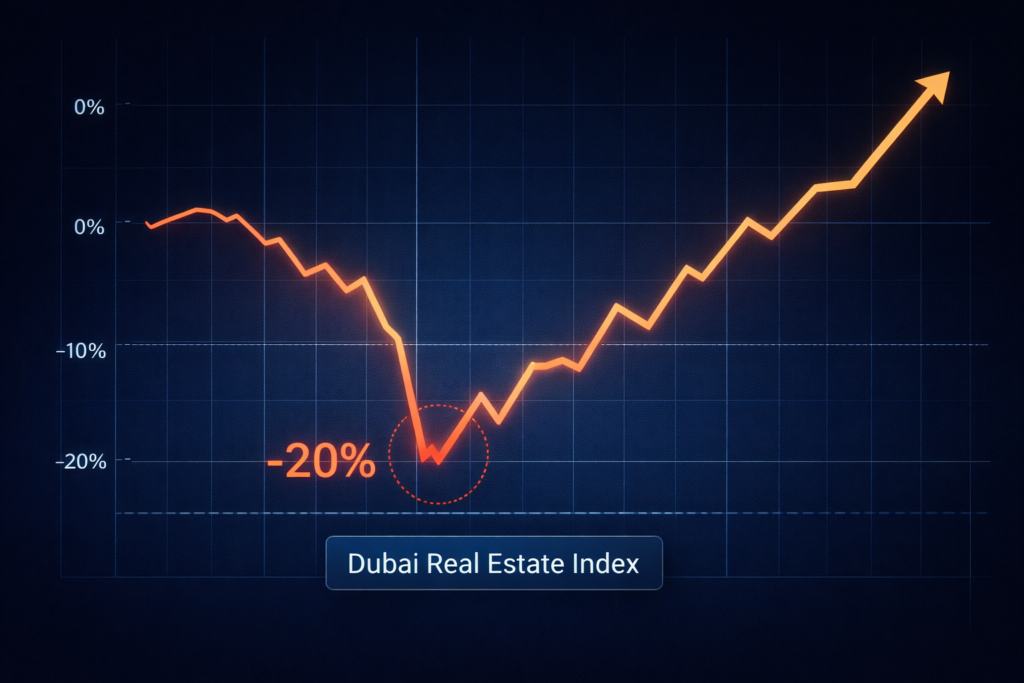
According to data cited by multiple market analysts, including reports tracked by Dubai Land Department sources, the DFM Real Estate Index dropped approximately 20% in the five trading sessions following the escalation, wiping out all its 2026 gains. Developer stocks fell sharply — Emaar Proper es and Aldar Proper es each declined around 5% on the day the news broke. Some international airlines suspended Middle East routes. Expats in certain communities began asking questions. Off-plan buyers grew nervous about project timelines and delivery certainty.
This is the mood on the ground. It deserves to be named clearly.
But sentiment and fundamentals are not the same thing. And in Dubai’s case — as in every previous crisis — it is the fundamentals that ultimately write the story.
The Market Did Not Break — It Paused
The critical distinction every serious investor must understand right now is this: a pause is not a collapse.
Even in the most turbulent weeks of March 2026, Dubai’s real estate market continued to transact. According to data reported by The National and tracked against Dubai Land Department records, Dubai recorded 3,570 property transactions worth AED 11.93 billion in the single week of March 2 to 9, 2026 — immediately after the conflict escalated. That is not a market in freefall. That is a market taking a breath.
According to CBRE’s analysis, the emirate recorded a 31% year-on-year rise in residential transactions to AED 395 billion in 2025. Crucially, 2026 transaction activity has remained ahead of the prior year’s pace even accounting for the March slowdown. The underlying pipeline of demand did not evaporate — it stepped back from the window.
Anshuman Magazine, Chairman and CEO for India, Southeast Asia, Middle East and Africa at CBRE, described what is happening as “a temporary pause in investor activity,” emphasising that “Dubai’s real estate fundamentals remain resilient” and that “the fundamentals haven’t changed — only the pace has moderated temporarily.”
That assessment matters. CBRE is not a promotional real estate agency. It is one of the world’s most respected independent commercial real estate analysts.
Dubai Has Seen This Before — Every Single Time, It Came Back
For anyone new to UAE real estate, the current environment may feel unprecedented. For those with institutional memory of this market, it is a familiar chapter in a well-worn playbook.
According to Sherwoods Property, which has operated in the UAE and UK real estate markets for over 38 years:
Every major geopolitical shock that has affected the Gulf region has followed the same basic sequence — immediate senment shock, motivated sellers emerging, then capital repositioning as investors from affected regions move capital into Dubai as a stable destination.
The pattern is consistent across every crisis the UAE market has lived through:
2008 Global Financial Crisis: Property prices in Dubai fell approximately 50% from peak, the most severe correction in the market’s history. By 2013, the market had fully recovered. By 2025, it had reached all-time highs, having delivered gains of over 60–75% in the post 2021 phase alone.
2020 COVID-19 Pandemic: Global borders closed, travel stopped, and oil prices went negative. It was described as the sharpest economic shock in a generation. Dubai recovered fully within 18 months. Investors who entered in mid-2020 recorded gains exceeding 60% in prime locations, according to market analysts.
2022 Russia-Ukraine War: Rather than damaging Dubai, the conflict accelerated capital inflows from Eastern Europe, with Palm Jumeirah and Marina recording some of their strongest transactions in years precisely because of instability elsewhere.
As noted in a detailed analysis by property analyst firm Veersant, based on verified official data from the Dubai Sta s cs Centre, Dubai Land Department, IMF, and UAE Central Bank: “Dubai comes back. Fast. And stronger than before.”
The 2026 conflict is serious. But it is not structurally different from what Dubai has already survived and grown through.
Also Read: UAE Gold Prices vs India: Why Dubai Remains the Preferred Destination for Gold Buyers
The UAE’s Structural Strengths Have Not Changed
It is worth being absolutely clear about what the Iran war has and has not changed about the UAE real estate market.
What has changed: Short-term investor senment, transaction pace, off-plan buyer hesitancy, developer pricing flexibility in certain segments, and the perception of regional risk among first-me international buyers.
What has not changed: Everything else.
Population trajectory: Dubai’s population surpassed 4 million in 2025 and is projected to reach 4.47 million by mid-2026, according to analysts at Mitchells Commercial Realty. The people who moved here for careers, lifestyle, tax efficiency, and safety have not fundamentally changed their calculus because of a conflict that is primarily happening hundreds of miles away and being actively intercepted.
The Golden Visa Programme: The UAE Government’s 10-year residency visa for property investors — with a minimum qualifying investment of AED 2 million — remains fully in place. This policy, administered through the Dubai Land Department, offers residency to long-term real estate commitment. It was designed precisely to weather short-term volatility and ensure buyers remain anchored to the market.
Tax-free income and zero capital gains tax: These are not changed by war. They are enshrined in UAE law. For a London buyer, a Mumbai investor, or a Moscow businessman, the net financial argument for UAE property versus alternatives does not shift because of a regional conflict.
Rental yields of 7–9%: Dubai continues to offer rental yields that dwarf most European and North American alternatives. This income reality does not disappear with geopolitical noise.
The Dubai Real Estate Strategy 2033 and D33 Agenda: The UAE Government’s commitment to positioning Dubai among the world’s top three economic cities by 2033 remains fully intact. Ins tu onal ambi on of this scale is not abandoned due to regional turbulence — if anything, stability-focused governments use periods of stress to accelerate reform and structural investment.
The Safe-Haven Paradox: Why War Sometimes Brings Capital to Dubai
There is a counterintuitive dynamic that sophisticated investors understand about Dubai — and it is particularly relevant right now.
Dubai has historically attracted more capital, not less, during periods of regional instability. The logic is straightforward: when the region around Dubai destabilises, wealthy individuals and institutions in nearby countries — Iran, Iraq, Lebanon, Pakistan, India — seek to park their capital somewhere with rule of law, a stable currency, strong governance, and a proven track record of protecting private wealth.
Where do they go? Dubai: According to TRENDS Research & Advisory, the Dubai International Financial Centre anchors a regional financial system through which capital flows across markets from South Asia to East Africa. This role does not diminish during a conflict. It intensifies.
Analysts at deVere Group note that the UAE “has repeatedly topped league tables for the country with the highest levels of millionaire migration,” and that while the conflict may cause disruption, “it won’t derail the trend, with the country’s generous tax regime and safe environment continuing to attract wealth and talent from around the world.”
According to GCC Edge, capital is not leaving the UAE — it is rotating within it, shifting between Abu Dhabi and Dubai depending on risk appetite, but remaining in the ecosystem. Abu Dhabi, with its more institutional and income-focused investor base, is actually racing to increase attention from capital preservation-focused buyers during this period.
Reading the Ground Reality: What Serious Buyers Are Doing Right Now
Beyond macro analysis, what is actually happening at the transactional level?
A-plus developers — Emaar, Aldar, Meraas — are largely holding pricing, waiting for senment to stabilise, according to market observers quoted in Business Today. B-grade developers are offering more flexible payment plans. C-grade developers are offering direct discounts. This ered response is not the signature of a collapsing market. It is the signature of a market undergoing a healthy, demand-driven recalibration.
Meanwhile, inquiry levels, investor discussions, and what analysts describe as “serious buyer activity” remain active, even if final transaction decisions are being delayed. There is a distinction between a buyer who has left the market en rely and a buyer who is watching carefully and waiting for the right moment to commit. Right now, Dubai is full of the latter.
Property analysts at Sherwoods note that distress deals and below-market acquisitions are appearing across prime locations, including Palm Jumeirah, Dubai Marina, and Dubai Hills Estate — “properties that were not available at these prices 12 months ago, and will not be at these prices 12 months from now.”
History suggests these are the moments that create general wealth — not the moments that destroy it.
The Risk Is Real — But It Is Bounded
Balanced analysis requires acknowledging the genuine risks on the table.
Fitch Ratings has warned that the effect on real estate values will depend on the conflict’s scope and duration. If the war escalates into a prolonged mul-year confronta on involving direct strikes on the UAE’s economic infrastructure, the impact would be materially more severe. S&P Global Ratings, cited by The National in March 2026, indicated that Dubai’s luxury property segment could soften if the conflict continues, with smaller developers potentially facing the most pressure.
Supply-side pressures are also emerging. The disruption of the Strait of Hormuz has impacted the shipping of construction materials — steel, cement, and aluminium — creating cost inflation in the building pipeline. Projects may face delays. Developer margins may compress.
These are real considerations, and any investor ignoring them is not doing proper due diligence.
However, the key question is not whether the risk is real — it clearly is. The question is whether the risk is permanent or temporary. Every piece of structural evidence points to the latter. The UAE’s governance model, defence capabilities, economic diversification, and geopolitical positioning are all designed around long-term resilience. As the Centre for Strategic and International Studies (CSIS) observed, the UAE “operates in the diplomatic world like a sophisticated investor… the goal is not near-term consistency so much as long-term returns.”
Also Read: UAE Salary 2026: Optimism and Opportunity in a Competitive Market
What the Recovery Will Look Like: A Timeline for Investors
Based on historical patterns and current market conditions, analysts are mapping out a likely recovery trajectory:
Short-Term (Next 4–8 Weeks): Transaction volume remains subdued. Some price flexibility continues, particularly in off-plan and secondary markets. Buyers with cash and a long-term horizon are quietly entering. This is the window that historically rewards the patient.
Medium-Term (3–6 Months): As geopolitical clarity improves — whether through ceasefire negotiations, de-escalation on, or simply the normalisation of a conflict that does not fundamentally alter UAE sovereignty — buyer senment recovers. Pent-up demand, which has been building throughout the pause, re-enters the market. Transactions on volumes surge. Developers who held pricing are vindicated.
Long-Term (6–24 Months): If historical patterns hold, this period produces above-average returns for those who bought during the correction. Post-2009, post-2020, and post-2022 all delivered this outcome. The UAE residential real estate market was, before this crisis, projected by analysts to grow from USD 36.3 billion in 2024 to USD 52.3 billion by 2030. A conflict-driven pause does not eliminate a six-year trajectory.
The Investor’s Honest Checklist for Right Now
Before making any decision — to buy, to wait, or to exit — serious investors should honestly answer these questions:
Has the UAE’s long-term population growth story changed? No. Have tax advantages disappeared? No.
Has the Golden Visa policy been cancelled? No.
Has Dubai ever permanently collapsed from a geopolitical shock? Never in its recorded history.
Are prices lower today than three months ago? In some segments, yes, which historically represents entry opportunity, not an exit signal. Is this the me for reckless, leveraged speculation? Absolutely not.
Is this a moment for long-term, fundamentals-driven investment at better prices than were available in January? The evidence strongly suggests yes.

Conclusion:
The Pause Is Not the Story. The Comeback Is.
The UAE real estate market in April 2026 is paused, cautious, and recalibrating. That is the honest truth, and it deserves to be acknowledged without spin.
But the pause has never been the story in Dubai. The comeback always has been.
From the darkest days of 2009 when prices fell 50%, to the paralysis of 2020 when borders closed globally, to the uncertainty of 2022 — Dubai’s real estate market has demonstrated a singular, consistent characteristic: it comes back, it comes back fast, and the investors who understood the fundamentals — not just the headlines — came back richer.
The current crisis tests something real: the UAE’s image as an unassailable safe haven. That image has been shaken. But shaken is not shaken. The infrastructure is intact, the governance model is functioning, the air defence systems are performing, and the structural drivers of demand — population growth, Golden Visa policy, tax advantages, economic diversification, and institutional investor confidence — are all still in place.
For buyers with a horizon beyond the next news cycle, the question is not whether Dubai will recover. The question is whether you will be positioned for it when it does.
Sources & References
The National — “Stability, Not Panic: Dubai Real Estate Companies See Steadiness Despite Iran War” (March 2026) | thena onalnews.com
CBRE Middle East — UAE Real Estate Market 2025–2026 Analysis | cbre.ae
Business Today (India) — “Dubai Property Paused on War Fears — Will US-Iran Ceasefire Bring Buyers Rushing Back?” (April 2026)
Dubai Land Department (DLD) — Real Estate Transactions on Data 2025–2026 | dubailand.gov.ae
CNBC — “Iran War: Dubai Scrambles to Save Its Reputation as Haven for Rich” (March 2026)
Middle East Council on Global Affairs — “Iran’s Regional Gamble and Its Implications for Gulf Security” (March 2026)
TRENDS Research & Advisory — “Between Norm and Protec on: The UAE, the 2026 Regional Conflict” (April 2026)
Centre for Strategic and International Studies (CSIS) — “The UAE: From Footnote to Sophisticated Global Partner” (2026)
IMF — UAE GDP Growth Projections 2025–2026
deVere Group — “The Resilience of Dubai Property: Driving Growth Amid Geopolitical Stress” (2026)
GCC Edge — “GCC Real Estate 2026: Market Resilience Amid Geopolitical Shock”
UAE Government Official Portal — Golden Visa Programme | u.ae
Fitch Ratings — UAE Real Estate Outlook Commentary (2026)
Disclaimer: This article is for informational and analytical purposes only and does not constitute financial, legal, or investment advice. Real estate investment carries risk, and readers are strongly advised to seek independent professional guidance before making investment decisions. Geopolitical situations can evolve rapidly — readers should verify current conditions at the time of their decision.